Aeronautics and defense: the process is mastered, the decision-making much less so
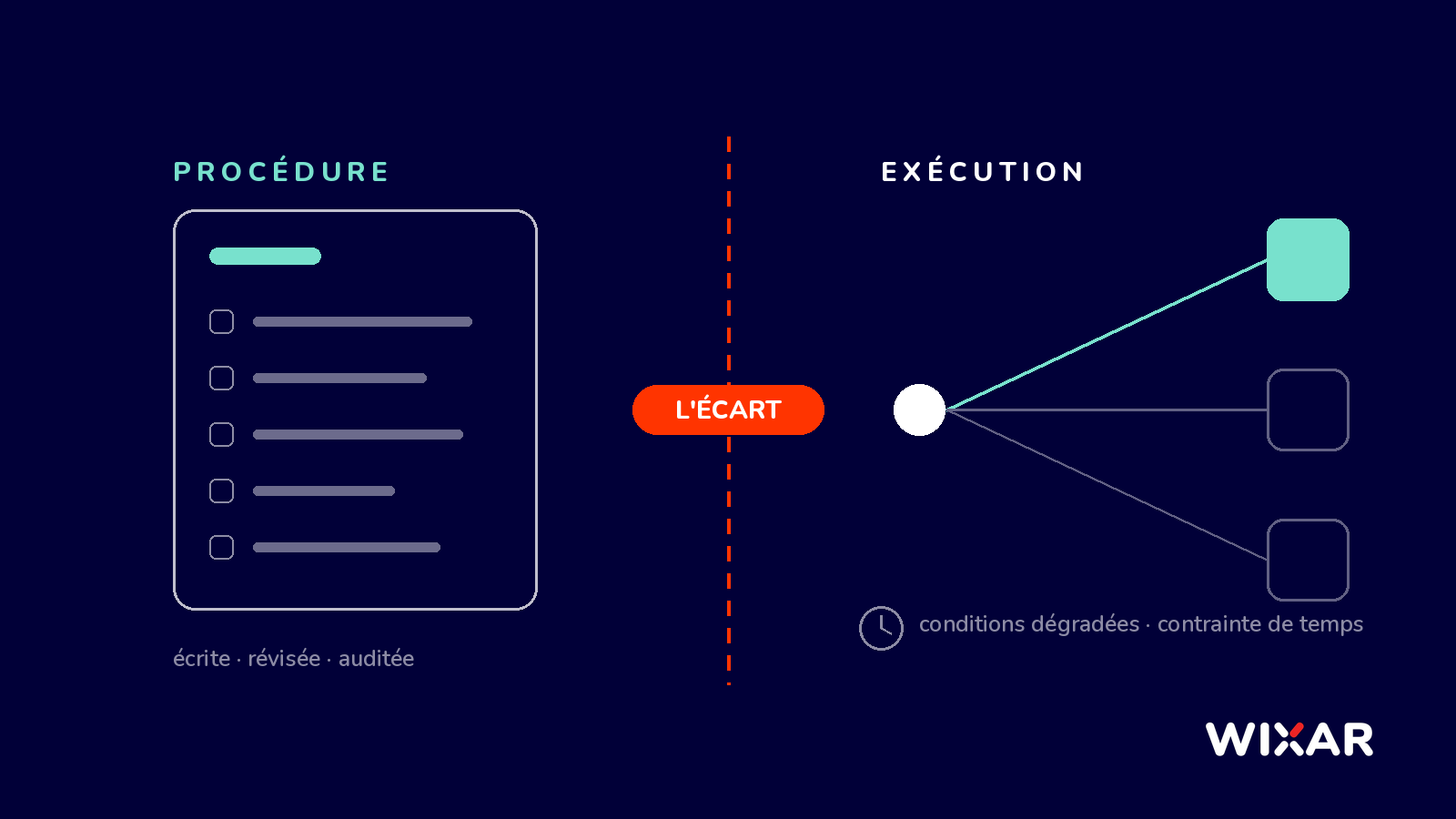
In the aeronautics, space, and defense industries, operational documentation is arguably the most well-maintained asset in the company. It is drafted, reviewed, versioned, audited, and sometimes mandated by a certification authority. When operators start their shift, they have access to a reference system whose quality is unmatched in most other sectors.
This is precisely what makes the training problem so counterintuitive. The performance gap almost never stems from a poorly written procedure. It lies in the difference between knowing the procedure and executing it correctly.
Where does the gap really lie?
Operational incidents rarely unfold exactly as described in the manual. They arrive with incomplete information, conflicting sensor data, an absent colleague, time pressure, or a passenger or third party reacting unpredictably. In a matter of seconds, the operator must do three things: recognize the situation, choose the applicable procedure, and execute it while the context continues to shift.
Traditional training handles the third step well, but almost completely ignores the first two. An e-learning module verifies that a learner can recall a procedure. It does not verify that they will know to identify it as relevant in an ambiguous situation. A multiple-choice quiz measures comprehension, not decision-making.
An employee can achieve a perfect score on a compliance module and still be unable to make the right call under degraded conditions.
This distinction is not merely rhetorical; it has a direct impact on evaluation. Organizations that drive their training based on completion rates fail to see this gap because their indicators do not measure it.
What immersion actually changes
The value of immersive learning does not lie in graphic realism, contrary to what typical sales demonstrations suggest. It lies in the fact that the scene forces a decision and then plays out the consequences.
In a well-designed immersive simulation, the learner does not just check a box. They take action, the situation evolves based on that action, and they experience the result of their choice—even when that result is negative. Error becomes actionable information rather than a penalty. It is this mechanism, not the headset, that drives retention: we remember what we experience, not what we observe.
Three conditions determine whether a solution delivers on this promise.
The alternatives must be credible
A scenario where the right decision is obvious teaches nothing. The design challenge lies in creating plausible but incorrect options—the kind that correspond to shortcuts operators actually take in the field. These cannot be invented from a desk; they must be gathered from supervisors and internal feedback.
Debriefing must focus on decision-making
Simply providing a score is useless to a trainer. Knowing that twelve out of twenty learners chose the same incorrect option at the same point in the scenario reveals a collective weakness, and sometimes a flaw in the procedure itself rather than the training. This insight is the true analytical deliverable of a simulation.
The system must remain modifiable by the organization
Procedures evolve, fleets change, and feedback necessitates corrections. If every update requires commissioning new development, the system becomes obsolete and no one will fix it. This is why no-code editing by training teams is not just a convenience—it is a requirement for the content's survival.
The headset is not the point
Virtual reality remains associated with logistical constraints: purchasing equipment, managing it, sanitizing it, and moving it between sites. These constraints are real, and they have caused a significant number of pilot projects to fail.
The same immersive scenario can be delivered on a workstation, tablet, or headset. The device determines the intensity of the immersion, not the nature of the exercise: the decision-making, the scenario flow, and the debriefing remain identical. This allows for broad deployment on PCs, while reserving headsets for situations where physical engagement and stress provide specific pedagogical value, such as working at heights or face-to-face conflict management.
Asking about the device before the scenario is the most common framing error.
What we can measure, and what we cannot yet
A moment of honesty is needed here, as it is rarely provided by industry suppliers. The data currently available in the sector primarily concerns satisfaction, engagement, and perceived realism. These are first-level indicators. Demonstrating a lasting transfer to on-the-job behavior, and subsequently an effect on safety metrics, requires a tracking protocol that few organizations have implemented to date.
The most demanding buyers ask this question, and they are right to do so. The serious answer is to build the protocol with them from the pilot stage, by identifying the existing business indicator the program is intended to influence, rather than producing a performance figure with an unknown calculation method.
An example at Air France
Air France uses WiXar for a dedicated program preparing its cabin crew to manage in-flight incivility. The difficulty of this subject illustrates the point well: the procedure is documented, but its application depends on a quick assessment of a passenger's behavior in a confined space, in front of witnesses. The program won an award this year.
We will be discussing this at AéroSud on September 17, 2026
WiXar is an exhibitor at the fourth edition of AéroSud, held at the Aix-les-Milles airfield. The event is organized by the SAFE Cluster, of which we are members, with the support of the Southern Region, the Aix-Marseille-Provence Metropolis, and industry leaders. It brings together stakeholders from the aeronautics, defense, and security sectors in the Southern region.
We will be presenting scenarios on workstations, tablets, and headsets, and we are preparing a demonstration based on a case similar to your own operations. Appointments can be scheduled in advance via the organizer's platform.
Frequently asked questions
Do all teams need to be equipped with headsets to deploy immersive training?
No. A scenario designed on WiXar can be delivered on PC, tablet, and headset from the same content. The headset is justified when physical engagement or stress is part of the learning objective, not as a prerequisite for using the system.
How does it differ from an enriched e-learning module?
An e-learning module evaluates the recall of a procedure. An immersive simulation evaluates the decision made in a degraded situation and provides the trainer with a breakdown of their team's choices rather than just a score.
Who designs the scenarios?
The organization's training teams, using a no-code authoring tool, with support from our designers if needed. This is essential for ensuring content can be updated as procedures evolve.
Stay informed