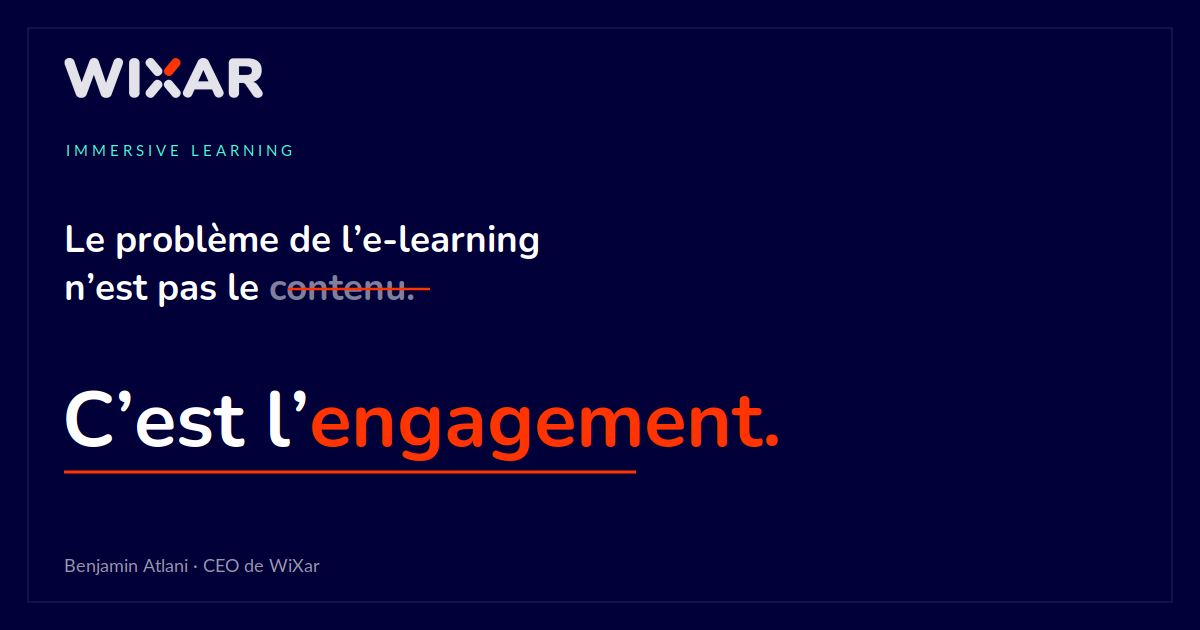
The problem with e-learning isn't the content; it's engagement — and that is where everything is won or lost.
In short — Immersive learning rarely fails due to a lack of content: it fails because the learner disengages. Virtual reality captures attention, but immersion alone is not enough to engage. What turns a learner into an active participant is story acting—giving control back to the learner so they become the architect of their own consequences—integrated with three proven pedagogical methods: Bloom's taxonomy (cognitive trajectory), the Houssaye triangle (posture), and the FALC method (cognitive load). These four levers do not operate by blending together, but as distinct layers of the same scenario. It is their interlocking structure that makes immersive learning effective—not their accumulation.
By Benjamin Atlani, CEO of WiXar — ten years in immersive learning, over one hundred projects. Updated May 2026.

The true vanishing point of immersive learning
For a long time, we believed the problem with e-learning was a content issue: not rich enough, not up to date, not interactive enough. This was a misdiagnosis. Content has never been more abundant, yet completion rates remain desperately low. Learners don't disengage because they lack information—they disengage because nothing compels them, in the truest sense, to stay. The module runs in the background while they check their emails.
Immersive learning was born precisely to break this passivity.
This vanishing point becomes a chasm as soon as we address soft skills. And these are precisely the skills most cruelly lacking where frontline staff face high-pressure situations: a public service receptionist, a healthcare worker dealing with a stressed patient or family, a salesperson facing an angry customer, or a security guard in a confrontation. For these roles, traditional training—a video on best practices, a quiz—transmits nothing usable: no one has ever learned to de-escalate an aggressive situation by watching someone else do it.
The problem is therefore not cognitive; it is motivational and experiential. And it is a problem we clearly identified as early as 2018: the two structural pitfalls of EdTech areabandonment — that is, engagement — and retention. Everything else follows from there. If you don't solve engagement, the rest is moot: perfectly structured knowledge that no one finishes is training no one.
Immersion solves engagement — but not in the way we think
Immersive learning arrived with a real promise in this specific area. In immersion—whether in virtual reality, 360°, or mixed reality—the learner is there : their brain accepts the environment as real, and they are no longer distracted by the outside world—no alerts, no notifications, no news feeds. Capturing attention, which is the prerequisite for all learning, is achieved almost mechanically by the device.
This is where the first misconception creeps in, and it is one of the most persistent we have encountered in ten years: believing that immersion is enough, and that being able to look around is the same as interacting. That is false. A learner turning their head in a 360° sphere remains a spectator. They choose where to look, but their path is predetermined, and nothing they do has any consequence. Immersion captivates; it does not make one an active participant. Confusing the two has produced quantities of expensive and perfectly passive VR content—360° films disguised as training.
Immersion therefore handles captivation, not engagement. To move from captured attention to real engagement, something else is needed.
Story acting: putting the learner in the driver's seat
This is the concept I have been developing since our first immersive projects in 2016, and which I formalized under the name story acting — [in a foundational article from 2018]. Its definition can be summed up in one sentence: giving control back to the spectator to make them the actor of their own consequences. Every decision the learner makes shapes the rest of the story; what they do matters, and they know it.
This concept was not born from pedagogy. It was born from game design and the science of motivation—work on spatial and emotional immersion (Björk and Holopainen), on narrative as a driver of attention (Ernest Adams), and on player motivation (Celia Hodent). This is precisely what makes it valuable for training: it brings into learning the only discipline that has made engagement its obsession, whereas traditional pedagogy has always been able to take it for granted. When a learner has to come to a classroom, engagement is not a design problem. In digital and autonomous learning, it becomes the problem—and it is the one that story acting tackles head-on.
The driving force is not entertainment, it isagency : the feeling of having control over how things unfold. This is what creates the emotional charge, and therefore the memory anchoring of a situation experienced rather than just read. To produce this effect, interaction must be offered at the right level, without overload, and as naturally as possible — what we call bio-inspiredinteractions, so intuitive they become invisible. The richness of an interaction lies in what you don't see: its apparent simplicity for the learner, despite the complexity of the processing behind the scenes.
Why story acting needs the three classic methods — and vice versa
Story acting is the engine. But an engine without a chassis goes nowhere. Engagement alone does not produce learning: it produces a memorable experience, which is not the same thing. For emotion to be converted into skill, three proven methods come into play — not as ingredients to be mixed, but as distinct layers of the same scenario.
Bloom's taxonomy (formulated by Benjamin Bloom in 1956, revised in 2001) provides the cognitive trajectory: remember, understand, apply, analyze, evaluate, create. In traditional training, we often get stuck at the first two levels. Immersion, because it makes you act, makes the higher levels operational: you no longer evaluate a decision on a quiz, you make it under pressure. Bloom determines what the learner must be able to do by the end.
Houssaye's triangle (1988) determines who is in the driver's seat and who steps back. Its counter-intuitive contribution is that you cannot activate all three poles — knowledge, instructor, learner — simultaneously: in any given situation, one of them "plays dead." A lecture silences the learner. Story acting deliberately shifts the situation toward the learner-knowledge axis: the instructor is no longer the direct transmitter, but becomes the scenario designer and debriefing facilitator, where their intervention has the most value. It is not a balance; it is a deliberate choice of stance.
The FALC method (Easy to Read and Understand) determines what we do not impose unnecessarily distracting. Designed for cognitive accessibility, it becomes a universal discipline in VR: in an environment already saturated with stimuli, any illegible instruction results in cognitive overload and kills the engagement you just ignited. One idea per message, a stripped-back interface, concrete vocabulary: we don't waste mental bandwidth on the tool, we reserve it for learning.
Let's take a concrete example: training for de-escalating verbal aggression.
A front-desk agent facing a user who is raising their voice and threatening to lose control. This is precisely the type of skill that no best-practice video can convey: you don't understand de-escalation, you experience it.
The story acting opens the scene and places the learner in the first person, face-to-face with the user. Their reaction—the choice of words, but also the timing and the tone they adopt—causes the tension to rise or fall in real time. They aren't just checking the "right answer": they live the consequences of a poorly adjusted tone just as much as a clumsy phrase.
Bloom structures the difficulty in the background: recognizing escalation signals, applying techniques for reframing and calming, and then analyzing a situation that resists, adjusting one's strategy when the first approach fails—the cognitive levels rise without the learner feeling like they are reviewing a study sheet.
Houssaye sets the posture: no instructor looming over the exchange; learning happens through direct confrontation with the situation, and the instructor reappears during the debriefing—where, for soft skills, their perspective on what transpired is invaluable.
FALC keeps the whole experience playable: the few instructions are short and unambiguous, the interface says only one thing at a time, and not a single ounce of mental bandwidth is wasted on "how it works" at the very moment when all attention must be focused on the other person.
All four operate simultaneously, on four levels, within the same minute of experience. Without story acting, Bloom's progression reverts to a passive path, Houssaye's shift falls back into passive transmission, and the simplicity of FALC only serves to deliver content that one endures. Without the other three, story acting produces a nice game from which nothing useful is retained. It is the interlocking of these elements that creates efficiency—not their accumulation.
This scenario is not specific to a town hall front desk. It is the same engine that can be applied wherever a professional absorbs public tension: the healthcare worker who must break bad news to an exhausted family, the salesperson confronted by an aggressive customer, the security guard who must enforce a rule without the tone escalating. The same signals to read, the same need to train for real, the same impossibility of succeeding with a video. What changes from one sector to another is the setting of the scene; what does not change is the mechanics that make the training effective. (See our dedicated page: training your staff in de-escalation when facing public aggression.)
What a hundred projects taught us about common misconceptions
In immersive learning, expertise isn't measured by the number of methods you cite, but by the number of mistakes you've stopped making. Here are a few convictions earned through experience:
Immersion does not automatically increase retention for everything. It excels at procedural and contextual learning—tasks, sequences of actions, decision-making in the moment—and at facilitating transfer to real-world scenarios that are too costly, dangerous, or rare to replicate. It is rarely the most efficient way to transmit purely declarative knowledge. Trying to make everything immersive is a common misconception; immersive learning is specific, not universal.
More technology does not mean more learning. Haptics, photorealism, and complex interactions are all additions that impress during a demo but hinder training if they don't serve an explicit pedagogical purpose. The novelty effect inflates initial results before fading; what remains is the quality of the scenario.
And the most common trap: making engagement an end in itself. Engagement is a means to an end. If it doesn't lead to a transferred skill, you've produced entertainment, not training.
From theory to the field
This mechanism isn't just a workshop model; it is verified through real-world deployments. During training on de-escalating verbal abuse against government officials, designed for INSEE (Ministry of Economy and Finance) (105 learners), 65% of existing staff stated after the session that they would change their behavior, and 88% found the situations realistic—realism being the prerequisite for any transfer. Earlier,Atalian staff were trained in virtual reality through gaming with WiXar, a case featured on BFM Business. These results measure reception and intent, not observed change in the field; they indicate a direction, not absolute proof of effectiveness.
Producing this mechanism without coding
The obstacle has never been the pedagogical relevance of immersive tech—it was the cost and complexity of production that kept good VR for a few budgets. WiXar breaks this barrier: a no-code spatial computing design interface that allows an instructional designer, without any development skills, to build scenarios where Bloom's taxonomy, Houssaye's triangle, FALC clarity, and story acting branching are orchestrated directly.
It is no coincidence that the method and the tool share the same history—from WideWebVR and the first 360° experiences to WiXar today. Story acting was designed to be produced, not just described. WiXar does more than just make VR accessible: it makes effective VR accessible—where technology serves engagement, engagement serves learning, and nothing is added that doesn't serve both.
Frequently Asked Questions
What pedagogical methods should be used for immersive learning training?Four levers complement each other: Bloom's taxonomy to structure cognitive progression, Houssaye's triangle to define the posture between trainer, learner, and knowledge, the FALC method to limit cognitive load, and story acting to engage the learner by making them responsible for the consequences of their actions. The goal is not to add them together, but to have them operate simultaneously on distinct levels within the same scenario—whether deployed in virtual reality, 360°, or mixed reality.
What is story acting?Story acting involves handing control to the learner so they become the architect of their own consequences: every decision shapes the rest of the experience. Formalized by Benjamin Atlani (WiXar) starting in 2016, the concept is derived from game design and motivational science, applied to immersive training to solve the engagement problem that traditional pedagogy did not have to address.
Why does traditional e-learning have low completion rates?Because its problem is not content, but engagement. A passive module, which one follows while doing something else, creates neither motivation nor lasting competence—especially for soft skills, which are acquired through situational practice, not by watching.
Does immersive learning really improve memorization?Immersion (virtual reality, 360°, mixed reality) excels in procedural and contextual learning and in transferring skills to situations that are difficult to replicate (risks, technical gestures, difficult interactions). It does not mechanically increase the retention of all types of knowledge and remains inefficient for purely declarative content. Its effectiveness depends on the quality of the scenario, not the technology used.
Can you create immersive training without knowing how to code?Yes. WiXar is a no-code spatial computing design tool that allows a training designer to build and adapt immersive scenarios without any development skills.
To learn more: discover how to train your agents in de-escalation when facing aggressive public behavior, or request a WiXar demo.
Subscribe to
WiXar Newsletter