Occupational risk prevention: when occupational health services build their own immersive modules
One prevention message for thousands of companies
An occupational health and prevention service speaks to companies of every size and trade: construction, transport, catering, industry, cleaning. The risks are known, and so are the messages. What is missing is the moment when the employee lives them, rather than reads them.
For a prevention officer, the problem is not repeating the rule. It is making it real in the mind of someone who thinks it only happens to others.
The network's choice: build rather than buy
The network's services could have ordered turnkey modules. They chose the opposite: training their own teams to design on WiXar, to keep control of the content, adapt the scenes to local realities and produce the next modules without depending on a supplier. Some courses are built in-house, others co-created with WiXar.
Olivier Lamarche, ergonomist and digital project manager at Odalia, a member service of the network, saw it from the inside:
"The WiXar creation tool is truly user-friendly: it puts complex creation tools within reach of non-specialists. Placing interactions in the interface is child's play." (translated)
He also points out that you can build directly in an XR headset and see at once what the learner will see. That is what "lightweight" means at WiXar: a simulator that is quick to build, customisable by the teams themselves from their own documents, and easy to deploy.
Eight courses, one shared catalogue
The catalogue courses, built by occupational health services in-house or with WiXar, cover the trades where accidents are most frequent:
- Risks for delivery drivers
- Risks in the chemical industry
- PPE and risks on a construction site
- Risks of the waiter's job
- Risks in the kitchen
- Risks in hotel cleaning jobs
- Road risk
- MSDs and screen work
Each course launches from a simple URL, on PC, mobile or XR headset, so it can be deployed in a well-equipped company as easily as on an employee's phone.
Focus on the Road Risk module: five mini-games, one goal
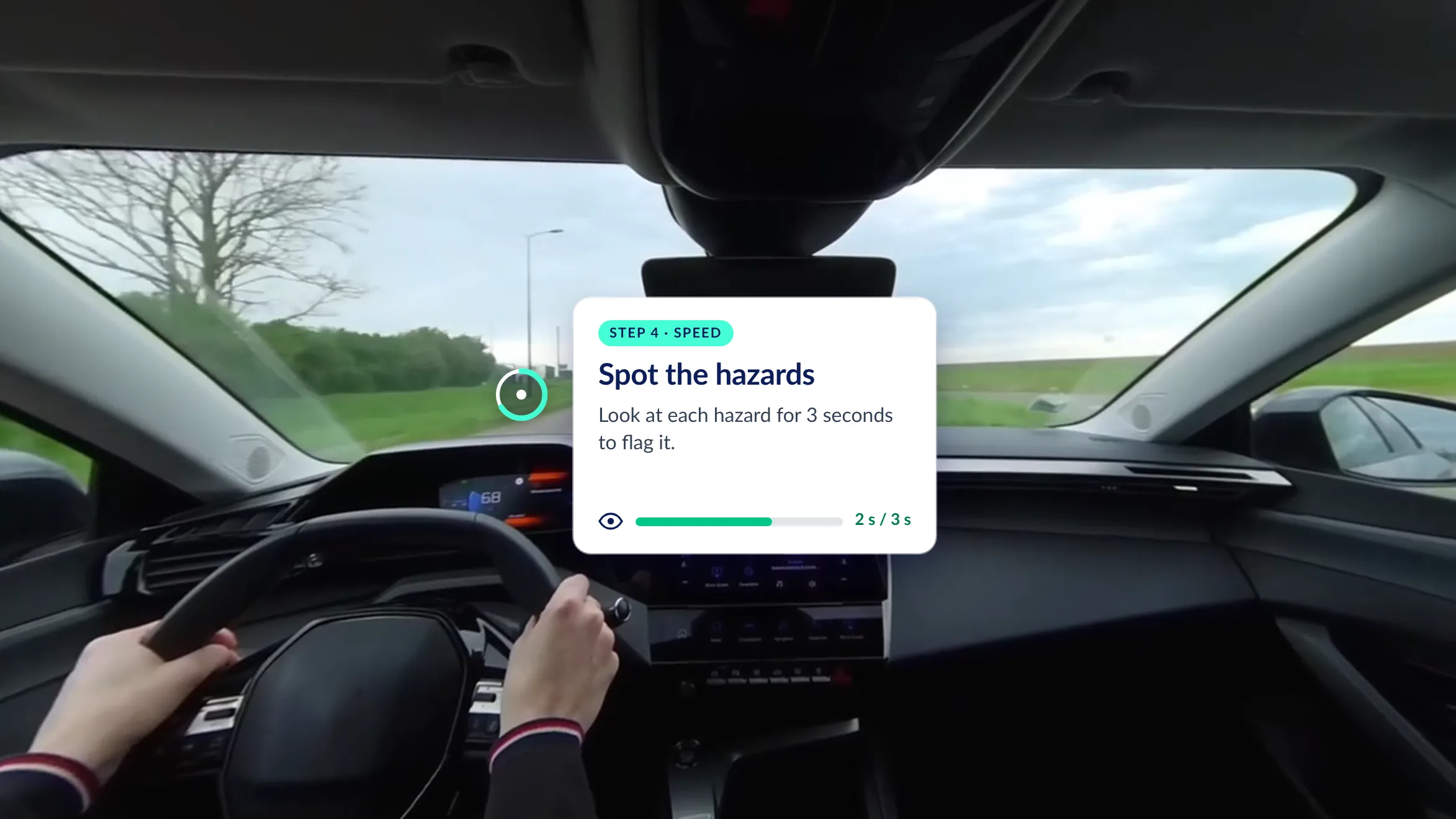
Built by WiXar with another occupational health service, then deployed by the network's services to their member companies' employees, this module puts the learner in the shoes of an employee with a company car. From the car park to the road, they go through five mini-games, each on one specific reflex:
- The vehicle checklist before starting.
- Safe following distances.
- Blind spots, with cyclists.
- Distractions, such as the music volume.
- Alcohol.
Each mini-game takes a few minutes. You get it wrong, you see the consequence, you start again.
What trained employees say
From May 2025 to January 2026, 118 participants in the Road Risk module answered the end-of-module questionnaire.
- 99% say they are satisfied or very satisfied with the experience.
- 72% say they are very satisfied.
Only one of the 117 participants who answered this question said they were not very satisfied.
What this case shows
A prevention service does not need an agency to produce immersive training. It needs its own experts, its own situations, and a tool that leaves them in control. That is what the services of the Présanse PACA-Corse network put in place: courses designed by their own teams, and a shared catalogue across a network that looks after up to 2 million employees: every course built by one service can be picked up and adapted by all the others.
For occupational health services, HSE departments and prevention officers, that is the difference between delivering a message and making it lived. A poster is looked at, a video is sat through, a quiz is guessed. A scene where you drive off without checking the vehicle, miss the cyclist in your blind spot, see the consequence and start again leaves a mark the rule alone never does. Ergonomists and occupational physicians have known this for a long time; immersive training finally makes it possible at the scale of a whole network. We remember what we live, not what we watch.
Are you a prevention service or an HSE team? See a WiXar scenario built on your line of work
Stay informed