Incivility: how INSEE trains its interviewers to stay in control with the public
A job in contact with the public
An INSEE interviewer rings doorbells they do not know and calls people who never asked to be called. Most exchanges go well. Some do not: a flat refusal, suspicion, a rising tone, sometimes aggression.
The cost of these situations does not stop at the incident. After a difficult exchange, apprehension sets in. INSEE put it plainly: "Interviewers refuse to go back into the field after an assault." The fear of the next door weighs on engagement, on health at work and, in the end, on data collection itself.
Knowing is not reacting
Interviewers know the de-escalation rules. The problem lies elsewhere: under pressure, nobody recites a procedure, they react. And those reflexes are not built in front of a slide deck, nor in a role play between colleagues where everyone knows the ending.
To anchor the right reflexes, you need to have lived the situation, got it wrong, and started again.
What WiXar put in place
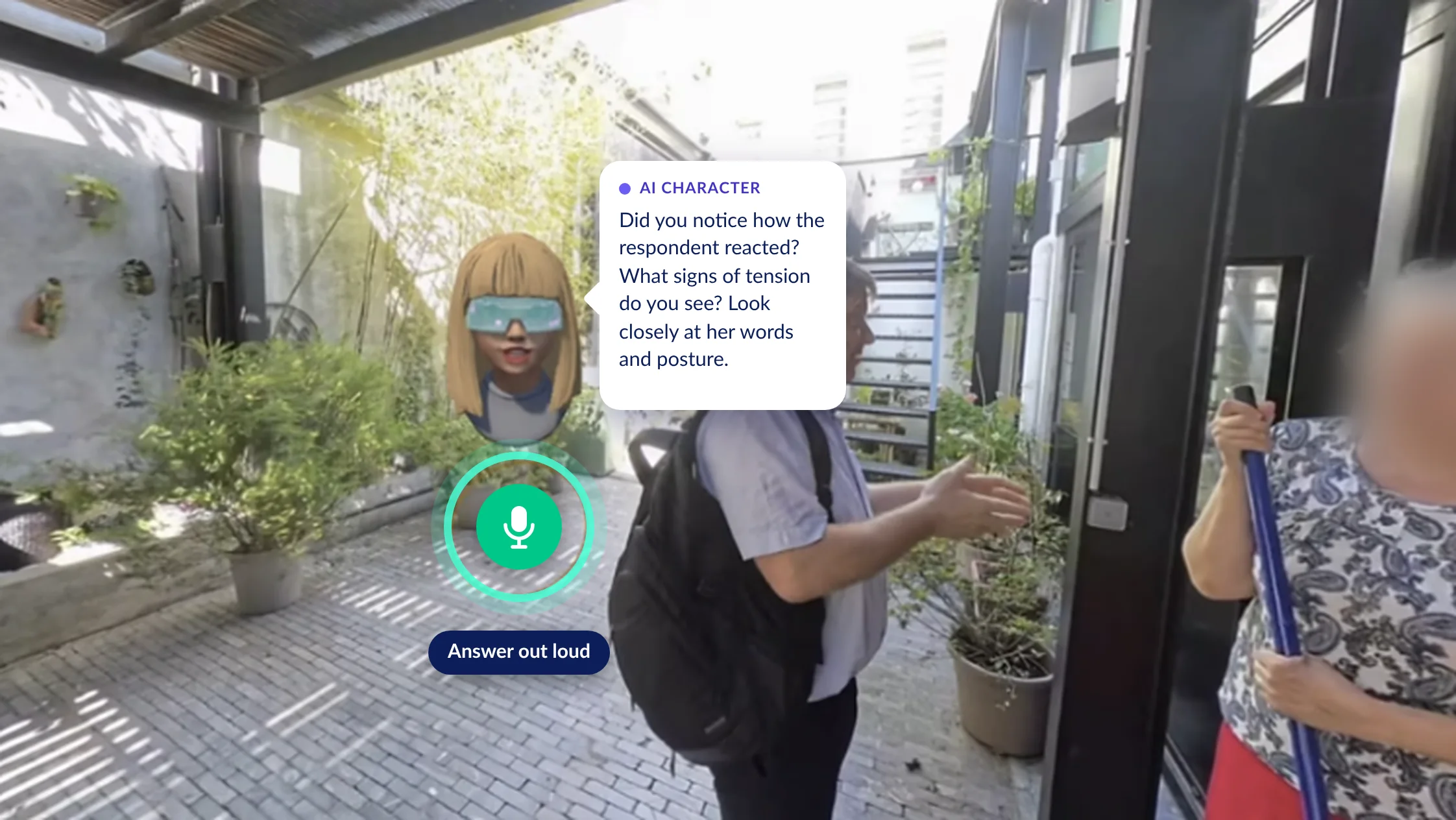
The interviewer steps into an immersive scene, on a doorstep or on the phone, facing a respondent whose tone is hardening. Beside them, an AI character with no script to follow: it reacts to what the interviewer says, raises or lowers the tension, and prompts them to spot the signs of irritation in the respondent's words and posture.
- A conversation that truly reacts. The interviewer speaks, the AI character answers, unscripted. Depending on the words and tone chosen, the tension falls or rises. The role play can bring several AI characters into the same scene.
- An instant debrief. At the end of the exchange, a spoken AI debrief goes over what worked, what raised the tension, and suggests other ways of phrasing it.
- Repeatable training. Every session is different. The interviewer can start again as many times as needed, until the right reflex becomes natural.
- A risk-free space. You train alone, with nobody watching, on a situation you would never choose to face in order to learn. Getting it wrong costs nothing.
This is where the essential is played out: human factors. Listening, rephrasing, setting a frame, knowing when to end the exchange, all while staying in one's professional role.
Results of the experiment
INSEE gathered feedback from the interviewers trained in three regional directorates.
- 100% rate the training as well or fairly well designed.
- 88% find the situations realistic.
- 94% want more immersive training.
- 65% say they will change their behaviour.
Compared with the training they already know, the course is rated more job-related by 88% of respondents, more engaging by 82%, more practical by 71% and better suited by 65%.
What this case shows
This case is not customer-relations training. It is psychosocial risk prevention. What wears an interviewer down is not the incivility itself; it is having gone through it without knowing what to do with it, and having to go back the next day.
The starting point was not a catalogue. INSEE and WiXar listened to the interviewers: the situations that put them in difficulty, the words that tip an exchange, what they wished they had known how to do. The training scenes come from there. That is why they find them realistic, and that is why it works.
Having played the scene ten times, facing someone who keeps cutting them off, changes one thing: the interviewer knows they can. That confidence is what protects, far more than the rule learnt. AI replaces no one here: it gives each person a counterpart that reacts, feedback on the spot, and the right to start again. We train humans with AI, not to replace them.
Front-desk staff, field technicians, security personnel, customer-facing teams: wherever someone faces the public under pressure, the same symptoms come back. INSEE chose to have its interviewers live the situation before it happens. We remember what we live, not what we watch.
Do your teams face the public? See a WiXar scenario built on your line of work
Stay informed