Training staff in de-escalation techniques for dealing with aggressive members of the public: the immersive solution
By Benjamin Atlani, CEO of WiXar — ten years of immersive learning, over one hundred projects. May 2026.
In short — Incivility and aggression toward public-facing professionals are on the rise across all sectors: at France Travail, reports of incivility jumped 82% between 2019 and 2023; in healthcare, reports of violence increased by 6.7% between 2023 and 2024. Behind every incident lies mounting stress, sick leave, and turnover.
However, traditional training—video, e-learning, quizzes—does not teach interpersonal skills: you cannot learn how to de-escalate an aggressive situation by watching someone else do it. WiXar allows you to create and deploy immersive learning experiences—virtual reality simulations—where staff can practice de-escalation in real-world scenarios, risk-free.
During a WIXAR training session for INSEE (105 agents), 65% of existing staff stated they would change their behavior, and 88% found the situations to be realistic.

A phenomenon affecting all public-facing roles
It is no longer just an isolated feeling: wherever professionals interact with the public, incivility and verbal aggression are on the rise.
At France Travail, reports of incivility jumped 82% between 2019 and 2023, and verbal aggression by 37% over the same period. In healthcare, the National Observatory for Violence in Healthcare (ONVS) recorded a 6.7% increase in reports between 2023 and 2024, with a 10% rise in physical violence alone.
In private practice, the Medical Council reported a 27% increase in declared assaults in 2023, and pharmacists reported a 30% increase. Retail, banking, transport: the same trend is emerging everywhere.
Part of this increase is due to better reporting—as the ONVS itself acknowledges. But it is precisely the convergence of sectors that do not coordinate with one another—healthcare workers, employment agents, shopkeepers, clerks—that reveals a deep-seated societal tension. Public-facing staff are absorbing daily aggression, and they are almost always on their own.
The cost does not end with the incident. An unprepared employee absorbs mounting stress, and it is this chronic stress that eventually fuels psychosocial risks (PSR), absenteeism, and turnover—three indicators that every HR department is currently trying to manage, often under regulatory requirements. Training for de-escalation is therefore not just about protecting the employee in the moment: it is about addressing the root of a costly HR problem.
Why traditional training fails exactly here
De-escalation is a relational skill. Yet, traditional e-learning hits a wall in this area for a simple reason: the problem isn't the content, it's the engagement.
A module watched half-heartedly while checking emails builds zero behavioral competence. You might understand the theory of rephrasing and calming a situation, but you don't know how to do it until you've experienced it under pressure, with real consequences.
This is even more true for soft skills than for technical tasks: there is no mechanical "right answer" to aggression. What matters is tone, timing, posture, and the ability to remain in control when the other person isn't. That cannot be taught through a video.
It is learned through repeated practice in real-world scenarios—something only simulation makes possible at scale, without exposing the agent to actual risk.
The solution: training in real-world scenarios through immersive learning
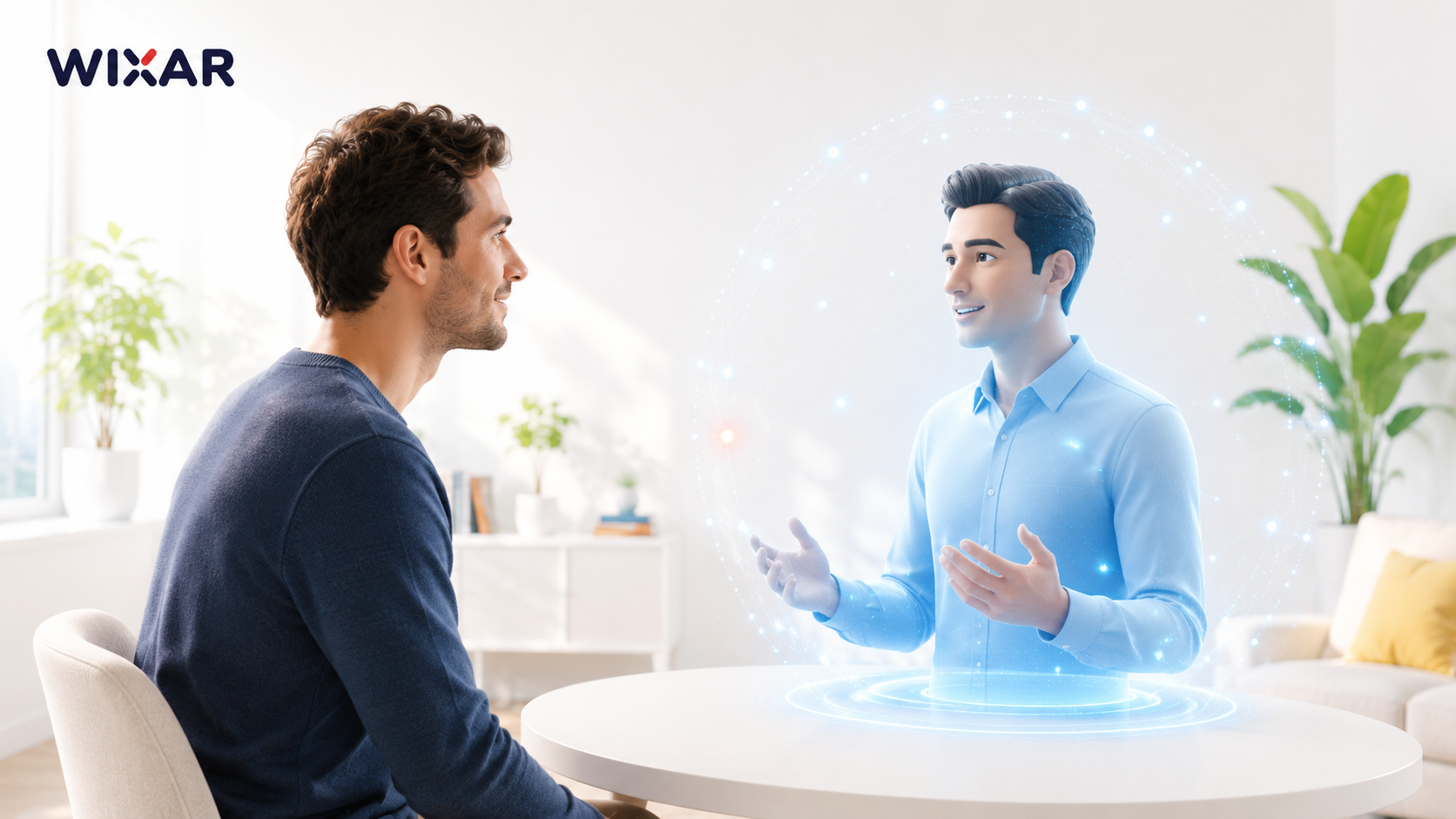
Immersive simulation places the agent in a first-person perspective facing an interlocutor who is raising their voice. They aren't just observing a scene: they are living it, and their reactions cause the tension to rise or fall in real time.
This is what anchors the learning — a lived situation is remembered as an experience, not as a fact sheet. This effectiveness is based on a precise pedagogical mechanism that we have been developing since our first immersive projects: story acting (giving control back to the learner so they become the architect of their own consequences) combined with proven pedagogical methods such as Bloom's taxonomy, the Houssaye triangle, and the Plain Language (FALC) method. The details of this framework are explored in our in-depth article on the four pillars of immersive learning.
How it works in practice: conversational avatars and AI coaching
At the heart of the WiXar system, the agent interacts with a conversational AI avatar — a virtual interlocutor powered by AI that reacts to what the agent says and how they say it. The avatar goes beyond just words: it takes into account the learner's emotions, tone, and pauses—all signals that cause tension to rise or fall in a real conversation. A correct sentence said with the wrong tone won't de-escalate a situation—the simulation reflects this, just as it would in reality.
These avatars are easy to set up in WiXar, with no technical skills required : trainers or safety officers can create their own characters and tailor them to their team's real-world situations (the impatient user, the customer who feels cheated, the person in distress).
After the simulation, an AI coach analyzes the interaction and provides the agent with a personalized debrief : what helped de-escalate the situation, what made it worse, and concrete tips for improvement in the next attempt. This feedback does not replace human debriefing—on a subject as sensitive as aggression, the trainer's perspective remains invaluable—but it allows everyone to practice independently as often as needed, arriving at the debrief with a clearer understanding of their own performance.
It is this loop— experiencing the situation in complete privacy and safety, measuring the effects, receiving feedback, and trying again —that turns a good intention into an acquired reflex.
The results: feedback from INSEE training
WiXar designed a de-escalation training program for INSEE—the National Institute of Statistics and Economic Studies, under the Ministry of Economy and Finance—to help staff handle insults and incivility. Following the sessions, 105 learners shared their immediate feedback:
65% of existing staff intend to change their behavior
88% find the situations realistic
94% want more immersive training
100% overall satisfaction
Two figures stand out above the rest. The perceived realism (88%) validates the prerequisite for any de-escalation training: without realism, there is no transfer of skills. And the intention to change behavior (65%) among existing staff is the most significant indicator—these are experienced professionals who, after the session, plan to modify their practice.
When asked what makes this different from their usual training—in-person or e-learning—learners describe the experience as immersive:
88% more relevant to the actual job
82% more engaging
71% more practical
65% more tailored
The first point is the most telling for de-escalation: being closer to the actual job than traditional formats is precisely the condition for transferring relational skills. Training that feels realistic is applied in real-life situations; training that feels like a chore remains theoretical.
These results measure reception, comparative perception, and immediate intent—not behavioral changes observed in the field. Nevertheless, they reflect what agents experience: less distress when facing aggression, improved listening, more effective de-escalation, and a better relationship with the public. Less distress, more excellence.
For which professions
The same system can be adapted wherever a professional has to handle public tension. What changes from one sector to another is the setting; what does not change, is the mechanism that makes the training effective.
-Public service and local authorities : reception staff, counter clerks, and government agents facing incivility from the public.
-Healthcare: caregivers dealing with stressed patients or families, delivering bad news, or managing tension in emergency rooms.
-Transportation — rail, air, and urban transit: operators and staff in direct contact with passengers, who are particularly vulnerable during delays, overcrowding, or incidents.
-Retail and commerce : sales associates and cashiers dealing with aggressive customers.
-Security : agents who need to enforce policies without the situation escalating.
Create your own scenarios, no coding required
WiXar enables companies and public organizations to turn critical procedures into operational reflexes. It is an immersive learning platform powered by AI agents, which teams manage autonomously to design, deploy, and analyze their training—based on their own real-world cases—four times faster than existing solutions. In practice, a training manager or safety officer can build and adapt their own de-escalation scenarios, using the specific vocabulary and real-life situations their agents face, without any development skills.
Frequently asked questions
Are incidents of incivility toward public-facing professionals really on the rise?
Yes, and across all sectors. At France Travail, reports of incivility rose by 82% between 2019 and 2023. In healthcare, the ONVS recorded a 6.7% increase in reports between 2023 and 2024. The French Medical Council noted a 27% increase in reported assaults in 2023, while pharmacists reported a 30% increase. While part of this rise reflects better reporting, the convergence across independent sectors confirms a fundamental trend.
How does a de-escalation simulation work at WiXar?
The agent engages in an immersive dialogue with an AI-powered conversational avatar that is sensitive to tone, pauses, and vocabulary—just like a real person. These avatars can be configured without any coding. At the end, an AI coach analyzes the exchange and suggests concrete areas for improvement, complementing the debriefing with the trainer.
How can you train your staff to handle aggressive users or clients?
The most effective way to build interpersonal skills is through situational training. Immersive learning, such as that offered by WiXar, places the agent in a realistic conflict scenario, allowing them to practice de-escalation repeatedly without any real-world risk—something no video or quiz can provide.
Is immersive learning effective for soft skills like conflict management?
Yes, that is precisely where it excels. Immersive learning is highly effective for contextual learning and transferring skills to situations that are otherwise difficult to replicate. During training at INSEE, 88% of learners found the scenarios realistic, and 65% of active staff planned to change their behavior.
Why is this better than traditional e-learning for de-escalation?
E-learning often fails not because of a lack of content, but because of a lack of engagement: you cannot learn interpersonal skills by just watching. Immersive simulation makes the learner responsible for their actions, which anchors the practice more effectively. At INSEE, compared to in-person training and e-learning, the immersive approach was considered more relevant to the actual job by 88% of learners and more practical by 71%.
Does de-escalation training help prevent psychosocial risks for reception staff?
That is the core issue. Staff who are better equipped to handle aggression experience less stress. The long-term goal of the prevention policies that include this type of training is to reduce psychosocial risks, absenteeism, and staff turnover.
Which professions are exposed to external violence?
Primarily frontline roles in contact with the public: public service reception and counter staff, healthcare workers, transport operators and agents (rail, air, urban), retail staff, and security personnel.
Can you create your own scenarios without knowing how to code?
Yes. WiXar is a no-code tool: scenarios can be designed and adapted without any technical skills, closely mirroring the real-life situations your staff face.
Would you like to evaluate immersive de-escalation training for your teams? Discover WiXar by requesting a demo (button at the top right).
Stay informed