Immersive debriefing: what research shows, and what it doesn't
I have been receiving immersive training specifications since 2018. They all describe pretty much the same things: the scenario, the environments, the expected interactions, the equipment, and sometimes success indicators. They almost all stop at the same point. What happens once the headset is taken off usually fits on half a line, if it is mentioned at all.
Episode 2 of "Regards Croisés," a series by AFXR and RA'pro, featuring Kelly Minotti (PhD, IBISC laboratory — Université Paris-Saclay) and Benjamin Atlani (CEO of WiXar).
This is the subject of the thesis that Kelly Minotti defended in December 2025 at Université Paris-Saclay, at the IBISC laboratory: Methods and tools for debriefing in virtual reality simulators. We discussed it for an hour for the Regards Croisés series. I am taking the time here to explain what she did, because her results deserve better than the treatment the market will likely give them.
Where the subject comes from
Kelly Minotti has an engineering background: ENSIIE, specializing in video games and digital interaction, followed by the RVSI master's program at IBISC as part of a dual-degree track. The subject was proposed to her by Guillaume Loup while she was already working at the laboratory. We know Guillaume well: we collaborated with him at WiXar as part of a CIFRE thesis.
The initial observation is simple to state and hard to dispute. Our sector spends most of its energy on the experience itself. We want realism, engagement, and interaction; we want to reproduce complex or dangerous situations.
All of this is necessary. But from a learning perspective, it is not always enough. The question Kelly Minotti asks is about the moment that follows. Once the headset is removed, what remains? How do we help someone understand what they did, what they missed, and what they could have done differently?
Fields that have been using simulation for a long time have already answered this question. In medicine, aeronautics, security, and crisis management, debriefing is an established practice. You don't just say "pass" or "fail"; you analyze the reasoning, the decisions, the errors, and the strategies. I see this regularly with the military, where we have several ongoing projects: the culture of debriefing there is old and solid, predating digital technology by a long time.
Immersive training has not inherited this culture. Debriefing there usually remains a verbal conversation, sometimes accompanied by a score, a few data points, or a video.
What a debriefing is, and why it determines the tool
A good part of the first year of the thesis was devoted to the state of the art of debriefing itself. It is this detour that makes the work applicable outside of the specific use case where it was tested.
There are many existing methods, and they are categorized differently depending on the school of thought, but they all share three stages. First, the reaction: immediately after, the learner says how they felt and where they stand, which allows the trainer to adjust the next steps based on their emotional state. Then, the analysis: reviewing what was done, explaining choices, and identifying errors. Finally, the summary: formalizing the lessons learned.
In practice, the headset is put on and taken off four times in a row. The learner wears it during the simulation for ten to fifteen minutes. They take it off for the immediate reaction, where they share their feelings with their trainer. They put it back on for the analysis, where they watch the avatar replay their actions and redo the failed sequences themselves. They take it off for the summary, which is done verbally.
Kelly Minotti has made a choice that I find remarkable, one that goes against the dominant reflex among immersive training developers, ourselves included: to make everything immersive simply because the technical capability exists. Her system only requires the headset for the second of the three debriefing stages: analysis. To be clear, because the term can be confusing: this is not the moment when the learner performs the exercise, but the moment after the simulation ends, when we review what happened. The immediate reaction and the summary are done without the headset.
The reason is physiological before it is pedagogical. Wearing a headset is limited by motion sickness, which is why training simulations generally last between ten and fifteen minutes. Adding a fully immersive debriefing would mean overloading the learner just when they need to catch their breath and speak face-to-face with their instructor. Furthermore, she was keen not to sideline the instructor, who remains the one leading the session.
Many people in our industry would do well to reread this paragraph. A researcher whose focus is immersive debriefing is intentionally narrowing its scope.
The system: Record, Review, Redo
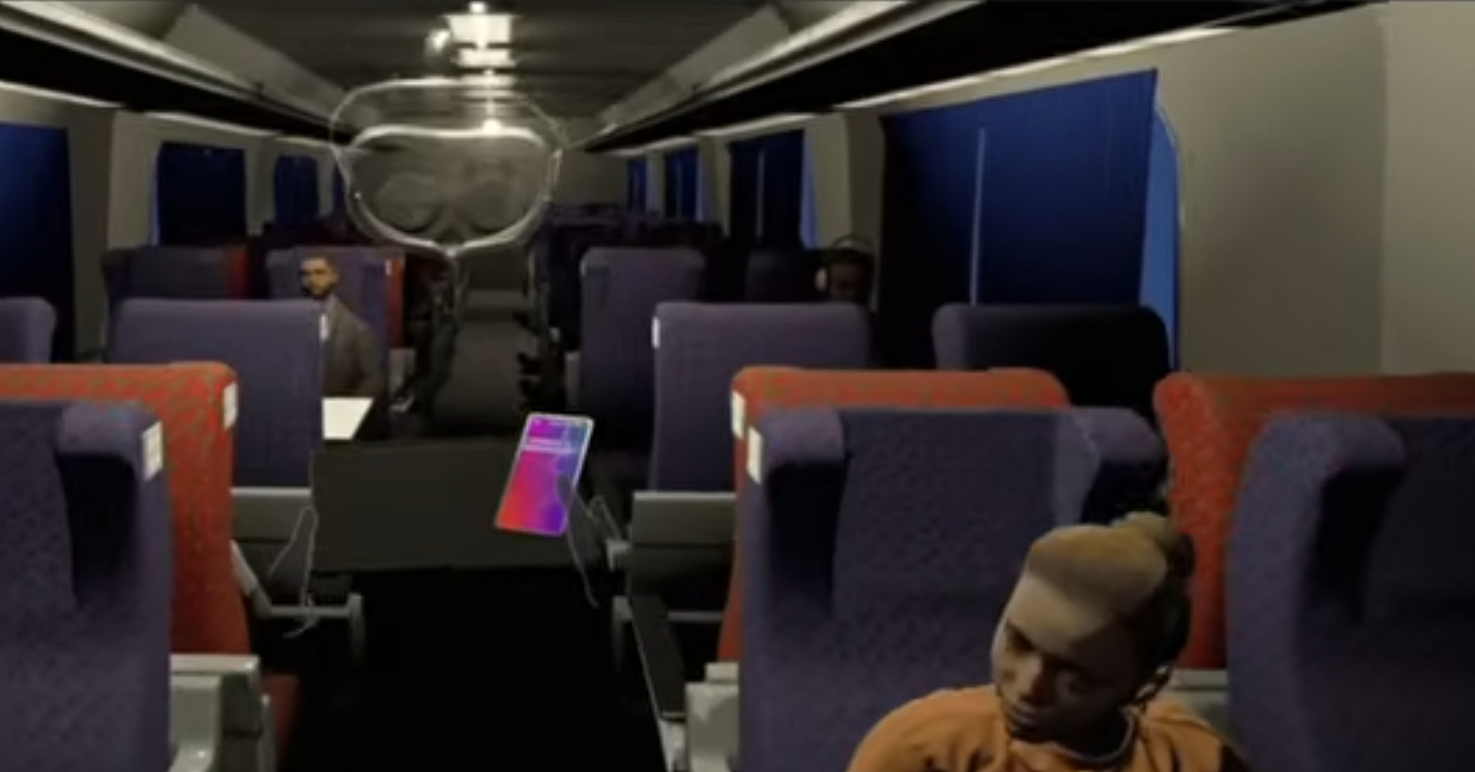
What she developed is called ReVeRSe. It is a Unity plugin designed to be added to an existing simulator rather than imposing a specific environment. It functions through three features.
Recording is the least visible yet most critical component. Training simulations are heterogeneous: some have only a few elements to track, while others have a vast amount. The approach taken is to natively record what is most common in Unity—movement and physics—and then allow the instructor to add simple scripts to track what is specific to their needs. A standard foundation and a lightweight extension. This optimization is what makes the system industrially feasible, and it went unnoticed in the discussion, even though it is just as valuable as the rest.
Reviewing brings the learner back into the environment, where an avatar replays their own actions. There are two differences compared to video. The perspective is in the third person, and movement is free: you can move around the scene. A video recorded from the headset provides a fixed, two-dimensional perspective that does not show what happened behind the learner or what they failed to look at. In safety training, what an operator did not look at is often the most useful information of the entire session. Navigation is also temporal: you can jump directly to the moment of interest.
Finally, redoing. The learner resumes the simulation at a specific point—where they made a mistake—and acts differently. They don't just comment on their error; they redo it differently and observe the consequences. The key refinement, which is the subject of the second study, involves redoing only specific segments rather than the entire simulation.
The results
Two comparative studies were conducted, focusing on long-term retention, motivation, engagement, and usability.
The first compares three ways of debriefing. The immersive system, limited at this stage to reviewing with the beginnings of redoing. Traditional debriefing, a simple oral discussion where the learner must rely on memory. And video debriefing, where the perspective recorded during the simulation is replayed.
All three yielded similar results. The team expected a clear advantage for the immersive system, but it didn't materialize. Upon analysis, they identified a limitation in the protocol: the simulator used was too linear. One action to perform, whether right or wrong, with three ways to correct it. There wasn't much to redo.
Hence the second study, based on a much richer scenario. A simulator for remote work on a train, themed around cybersecurity: the learner moves around with their laptop and phone, handles personal items, and must monitor their surroundings. Every action has consequences. Some errors remain fixable, while others trigger a critical failure that abruptly ends the session. This time, the redo function was fully operational, and the comparison focused on full redo versus segmented redo.
Here again, the learning metrics are comparable. The difference lies in the duration: segmented debriefing sessions are shorter, as you only revisit the moments that matter.
The public summary of the thesis uses broader language, mentioning an improvement in memorization, error analysis, and motivation. I asked her about this directly for this article. Her response: she wouldn't say that immersive debriefing systematically improves all metrics compared to oral or video methods. The summary's wording refers to the potential of the device and the benefits observed in terms of engagement, motivation, and error analysis. Regarding memorization, she remains cautious.
I find this caution valuable, and I will explain why.
How to read this without kidding yourself
The lazy conclusion would be to say that immersive replay adds nothing. That is false, but it forces us to shift the question and distinguish between three levels.
Regarding retention, no advantage has been proven, and the researcher who produced the most recent measurements is cautiously sticking to that. Therefore, no provider should sell recording and replay as an inherent gain in pedagogical efficiency. Yet, that is exactly what the market is doing.
Regarding engagement, motivation, and the quality of error analysis, benefits are observed, though they are not presented as being definitively superior to other methods. These variables are not just window dressing. A learner who reviews their decision rather than just recounting it is in a different state of attention. A trainer who has a navigable trace no longer spends their time arbitrating between two conflicting memories.
Finally, regarding implementation, the gain is direct and measurable. Segmented replay shortens the session. Free review shows what video cannot.
These last two levels determine whether debriefing actually exists within an organization. A short debriefing, where the material is immediately available and the learner is engaged, will happen. A long debriefing, relying on memory and experienced as a chore, is dropped as soon as the day gets busy. Debriefing is always the first victim of an overflowing schedule, never the exercise itself, because the exercise is what people came to do.
The value of immersive replay therefore hinges on whether the debriefing actually takes place, and under what conditions. This is the more useful of the two axes, and it is the one no one talks about.
What I observe from the corporate side
Our clients do not explicitly ask us for debriefing. The market is still immature in this regard, and the initiative comes from us. It is a process of evangelization, much like most practices that seem obvious today were in the past.
We have therefore made a different choice than the research community, for operational reasons. At WiXar, the debriefing is integrated into the experience itself: it happens live, right after a conversation with an AI-driven avatar, or at the end of the journey. There is no session to reschedule, no separate tool to open, and no second time slot to secure from the client. This constraint of operational simplicity governs all our product decisions, because a debriefing that requires additional organization is a debriefing that will not happen.
This debriefing is shorter than a session led by a trainer with a replay tool, and it does not aim for the same depth of analysis. It is verbal, therefore immediate, without any manipulation or logistics. And it relies on a corpus of documents specific to the client—their procedures, their standards, their internal guidelines—that the AI has in its memory. The learner is corrected on their own procedure, not on a generic best practice. We prefer a simple, effective debriefing that actually happens over a rich one that needs to be scheduled. And the approach is catching on: clients who have seen it in action come back for it on their own, even though none had asked for it initially.
My core conviction remains learning through error. Making mistakes yourself and seeing the consequences in an environment where they cost nothing—that is where the brain encodes information. This is what I called "story acting" in 2018: you don't remember what you watch, you remember what you inhabit.
Debriefing extends this mechanism. I don't describe it as the heart of the system, and I maintain this hierarchy while knowing that the simulation literature is stricter than I am on this point: exposing someone to a simulated crisis without a structured debriefing provides little benefit. This disagreement is worth stating rather than glossing over in a brochure.
Something else must be added, which fifteen years of training have taught me and which people don't like to say in a series dedicated to research. Pedagogical efficiency is just one parameter among many in training purchasing decisions. Showing up with a flag and an experimental result doesn't trigger anything. What decides it is the friction of deployment.
This market started strong about ten years ago, it has had its ups and downs, and it remains held back by hardware and the complexity of implementation. Any added complexity on the client side is a barrier, regardless of its pedagogical value.
During our discussion, Kelly Minotti asked if I would integrate a review and replay feature into our platform. My answer is conditional, and I won't give it any other way. If the integration represents almost no additional effort for the client compared to what is already deployed, then yes, that is the direction we should take. Otherwise, no, even with spectacular results. And I don't see the fleet of headsets changing enough in the next two to three years to alter that equation.
Regarding AI, my message is nuanced. Generating an automatic analysis is simple and inexpensive today. The problem is that AIs produce averages. Getting an average result is immediate. To get a truly good result, you need an infrastructure designed for it, capable of leveraging the organization's documents and business data.
That is the work that makes the difference, and we are working tirelessly on it at WiXar. Access to the model itself is no longer a competitive advantage for anyone. As for the trainer, their place remains essential, but their role is changing: they must arrive with a toolkit that includes AI, with a human providing the final validation. This is a fundamental position for us.
On this point, there is clear convergence with Kelly Minotti's work. The authors themselves identify intelligent assistance as the next project: automatic identification of segments to discuss, anomaly detection, and suggestions for the trainer. AI should be used for debriefing preparation, not for conducting the debriefing itself.
Five implications for design
Write the debriefing at the same time as the scenario. Study 1 shows this by the negative: a linear scenario cannot be debriefed because there are no decisions to analyze. This is a pedagogical design flaw that no tool can fix.
Build decision points with differentiated consequences. The second protocol was only possible because the scenario included both recoverable and fatal errors.
Segment the replay. Two or three sequences. The measured benefit relates to session time, and session time determines whether a debriefing even happens.
Do not make the headset mandatory during the debriefing. Let's clarify what we are talking about, as the terminology can be confusing: the analysis in question here is not the moment when the learner performs the exercise, but the second phase of the debriefing, once the simulation is over. That is the only time putting the headset back on is useful. Even then, the learner must be given the choice: some have no desire to put it back on after fifteen minutes of exercise, and forcing the issue ends up degrading the session just to satisfy a design intention.
Clearly state what is done with the recorded data. An instrumented simulation produces a detailed record of an employee's behavior: their hesitations, their errors, what they looked at, and how long they took. If this record can end up with their manager or in their performance review file, they will stop working and start protecting themselves.
They will perform the exercise defensively, avoid taking risks, and the debriefing will become an exercise in justification. Three points must be decided before deployment and communicated to learners: who has access to the recordings, how long they are kept, and what they can or cannot be used for. The last point is the most important. Training data that feeds into HR decisions is no longer training data.
What is still missing
Long-term retention is the least well-established metric in the field, yet it is the one the market most readily promotes. This is a state-of-the-art problem before it is a vendor problem: Kelly Minotti's thesis, with a controlled protocol and two comparative studies, also concludes with caution on this point. In corporate immersive training, the measurement of on-the-job behavior is almost absent from the literature. Systematic reviews in the field show this unambiguously: the overwhelming majority of studies stop at reaction and immediate learning; transfer is rarely tested, and actual behavior in a work situation is almost never tested.
This is the area we are interested in. Laboratories have the protocol; we have the real cohorts and work situations. This is what partnership-based research enables, and it is why we conduct it.
Kelly Minotti cites two disciplines that were missing from her setup: educational sciences, since the debriefing is the moment when a lived experience becomes learning, and cognitive psychology, for attention, cognitive load, and transfer. The remark applies to the entire sector and indicates where to recruit.
The value of this work is not to validate what we sell after the fact, but to know what doesn't work before we deploy it to a client.
Acknowledgments
Thanks toAFXR and RA'pro for the invitation, and for a series that truly fosters a dialogue between research and industry rather than just juxtaposing them. Thanks to Kelly Minotti for the precision of her answers, including regarding what her results do not demonstrate.
References
Minotti K. (2025). Méthodes et outils de débriefing des simulateurs en réalité virtuelle. Doctoral dissertation, Université Paris-Saclay, IBISC laboratory. theses.fr/2025UPASG082
Minotti K., Loup G., Harquin T., Otmane S. (2024). Exploring Immersive Debriefing in Virtual Reality Training: A Comparative Study. ACM VRST '24.
Minotti K., Mai D.X.H., Loup G., Chellali A., Ferrer M.-H., et al. (2025). The Immersive Debriefing: Comparative Evaluation of Full and Segmented Redo Methods in Virtual Reality.
Benjamin Atlani is the co-founder and CEO of WiXar, an AI-driven immersive training platform that transforms business procedures into training programs for high-stakes sectors: maritime, defense, aeronautics, and transport. He has been working in training for about fifteen years, formalized the 360° story acting concept in 2018, and has supervised a CIFRE doctoral thesis. WiXar is based in Paris and Aix-en-Provence.
Subscribe to
WiXar Newsletter

